
Dossier caiana #30
DOSSIER CAIANA #30
El arte abstracto en plural: perspectivas contemporáneas
Abstract Art in The Plural:
Contemporary Perspectives
Coordinadoras / Coordinators:
Dra. Heloisa Espada
(Universidad de São Paulo, Brasil) / (Universidade de São Paulo, Brazil)
Dra. Ana M. Franco
(Rice University, Estados Unidos) / (Rice University, United States)
CONVOCATORIA CERRADA
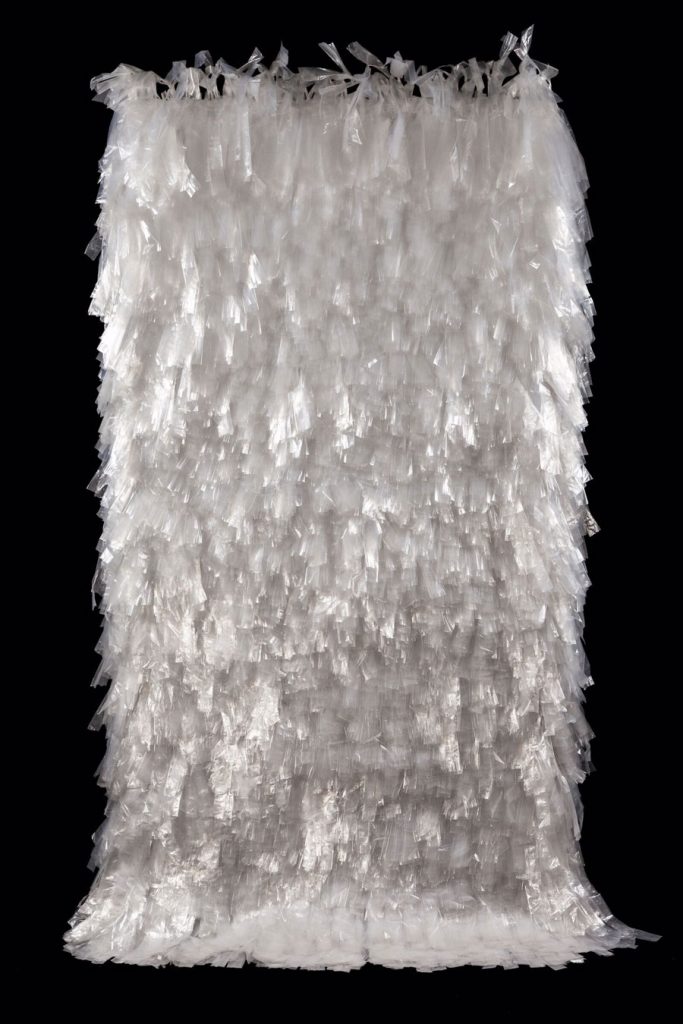
Olga de Amaral, Luz blanca, 1969, polietileno tejido.
Olga de Amaral, White Light, 1969, woven polyethylene.
En su libro On Abstract Art (1997), la historiadora de arte británica Briony Fer llamó la atención sobre la variedad de obras y teorías que se agrupan bajo el término “arte abstracto”, argumentando que éste se refiere a experiencias que no tienen nada en común salvo el rechazo a representar las apariencias del mundo. La idea de que las formas y los colores por sí solos son capaces de expresar realidades invisibles —ya sean especulaciones filosóficas, conocimiento espiritual, estructuras microscópicas, conceptos matemáticos o emociones— o de constituir buen arte por sí mismos, constituyó una de las creencias más influyentes del arte moderno. Sin embargo, desde las primeras manifestaciones abstractas a principios del siglo XX, han surgido críticas a la creencia en la autonomía del arte y a la noción de que el arte abstracto es un lenguaje universal capaz de trascender las especificidades culturales e históricas. Es significativo que, en su libro, Fer trata de poner de manifiesto “lo sistemático que es un patrón de represión dentro de una tradición abstracta” y “llamar la atención sobre las perturbaciones, las corrientes contrarias, que pueden observarse y que marcan ese mismo conjunto de obras” (Fer 1997, 5). Especialmente a partir de la década de 1960, artistas y teóricos alineados con perspectivas sociales y/o feministas comenzaron a cuestionar sistemáticamente la creencia en el carácter autónomo y universal del arte. Siguiendo los primeros cuestionamientos de Fer a la abstracción y con el objetivo de subsanar las injusticias históricas y ampliar los criterios analíticos, los estudios recientes han allanado el camino para una amplia revisión historiográfica de las motivaciones estéticas, espirituales, teóricas y sociales que han configurado —y siguen configurando— la producción de obras abstractas.
Este dossier tiene como objetivo reunir textos que reflejen el estado actual de la investigación sobre el arte abstracto en diferentes regiones del mundo y a lo largo de un amplio marco cronológico. Reconociendo la obsolescencia de las narrativas modernistas, damos la bienvenida a nuevos enfoques y propuestas teóricas que se centren en las historias del arte abstracto en los siglos XX y XXI. Nos interesan especialmente los estudios basados en perspectivas de género, los análisis de las tensiones raciales y étnicas, la ampliación de las fuentes de investigación, los medios y los resultados creativos, así como los análisis del carácter transnacional del arte abstracto, incluyendo la investigación sobre artistas anteriormente ignorados por la historia del arte y las recientes reevaluaciones de las implicaciones socioculturales de la abstracción. El dossier pretende abordar tanto las producciones modernas como las contemporáneas, así como la propia relevancia de la idea del arte abstracto en el contexto actual.
Invitamos a presentar contribuciones que aborden, entre otros, los siguientes temas:
- El arte abstracto y la espiritualidad;
- La abstracción y la colonialidad;
- Perspectivas de la diáspora africana sobre el arte abstracto;
- El arte abstracto y los contextos indígenas;
- Mujeres artistas en la abstracción;
- La abstracción y la decoración;
- La abstracción en el diseño y las artes aplicadas;
- Reevaluaciones críticas de la abstracción modernista;
- El arte abstracto y el primitivismo;
- Las materialidades de las obras abstractas;
- El arte abstracto en las exposiciones;
- Las dimensiones transnacionales de la abstracción;
- El arte abstracto y la naturaleza;
- La abstracción y la realidad.
REFERENCIAS
ALMQVIST, Kurt & BELFRAGE, Louise (orgs.). Hilma Af Klint. The Art of Seeing the Invisible. Axel & Margaret Axson Johnson Foundation, 2015.
ALVAREZ, Mariola V.; FRANCO, Ana M.. (eds.). New Geographies of Abstract Art in Postwar Latin America. Routledge, 2019.
ANSA GOICOCHEA, Elixabete; FRANCO, Ana M. “Dossier: Los Constructivismos del Sur”, H-Art. Revista de Historia, Crítica y Teoría del Arte Vol. 1 No. 10 (2022). https://doi.org/10.25025/hart10.2022.02
CHADWICK, W., Significant Others: Creativity & Intimate Partnership. Thames & Hudson, 1996.
CROWTHER, Paul and WÜNSCHE, Isabel. Meanings of Abstract Art. Between Nature and Theory. Routledge, 2012.
ESPADA, Heloisa (Org.). Gerado de Barros e a fotografia. Instituto Moreira Salles, 2014.
FER, Briony. On Abstract Art. Yale University Press, 1997.
GARCIA, María Amalia. El arte abstracto. Intercambios culturales entre Argentina y Brasil. Siglo XXI, 2011.
FRANCO, Ana M. Neoclásicos: Edgar Negret y Eduardo Ramírez Villamizar entre París, Nueva York y Bogotá, 1944-1964. Ediciones Uniandes, 2019.
GILBERT, Zanna et al. (org.). Purity is a Myth: The Materiality of Concrete Art from Argentina, Brazil, and Uruguay. Getty Conservation Institute and the Getty Research Institute, 2021.
KARMEL, Pepe. Abstract Art: A Global History. Thames and Hudson, 2020.
MERCER, Kobena (ed.). Discrepant Abstraction. MIT Press, 2006.
NELSON, Adele. Forming Abstraction: Art and Institutions in Postwar Brazil. University of California Press, 2022.
PÉREZ-BARREIRO, Gabriel (ed.). Geometry of hope. Latin American Art from the Patricia Phelps de Cisneros Collection. Blanton Museum of Art-The University of Texas at Austin, 2007.
PLANTE, Isabel. “Ambición profesional y vocación universal sudamericanas. París como arena cultural para la abstracción geométrica de la posguerra a los años sesenta”. En París pese a todo. Artistas extranjeros 1944-1968, Serge Guilbaut (cur.). Museo Nacional Centro de Arte Reina Sofía, 2018.
PLANTE, Isabel. “Kinetic Multiples: Between Industrial Vocation and Handcrafted Solutions”. En Keep It Moving? Conserving Kinetic Art, ed. Rachel Rivenc and Reinhard Bek. The Getty Conservation Institute, 2018.
SMALL, Irene V. The Organic Line. Toward a Topology of Modernism. Zone Books, 2024.
WÜNSCHE, Isabel and GRONEMEYER, Wiebke. Practices of Abstract Art. Between Anarchism and Appropriation. Cambridge Scholars Publishing, 2016.
In her book On Abstract Art (1997), the British art historian Briony Fer already drew attention to the variety of works and theories gathered under the umbrella of abstract art, arguing that the term refers to experiences that share nothing in common except the refusal to depict the appearances of the world. The idea that forms and colors alone are capable of either expressing invisible realities — whether philosophical speculations, spiritual knowledge, microscopic structures, mathematical concepts, or emotions — or standing as good art on their own, constituted one of the most influential beliefs of modern art. Since the earliest abstract manifestations in the early twentieth century, however, there have been critiques of the belief in the autonomy of art and of the notion that abstract art could function as a universal language capable of transcending cultural and historical specificities. Significantly, in her book, Fer sought to expose “how systematic is a pattern of repression within an abstract tradition” and “to draw attention to the disturbances, the counter-drifts, which can be seen to mark the same body of work.” (Fer 1997, 5). Especially from the 1960s onward, artists and theorists aligned with social and/or feminist perspectives began to systematically challenge the belief in the autonomous and universal character of art. Following Fer’s early challenges to abstraction and seeking to redress historical injustices and broaden analytical criteria, recent scholarship has paved the way for an extensive historiographical revision of the aesthetic, spiritual, theoretical, and social motivations that have shaped — and continue to shape — the production of abstract works.
This dossier aims to bring together texts that reflect the current state of research on abstract art in different regions of the world and across a wide chronological scope. Acknowledging the obsolescence of modernist narratives, we welcome new approaches and theoretical proposals that focus on histories of abstract art in the twentieth and twenty-first centuries. We are particularly interested in studies grounded in gender perspectives, analyses of racial and ethnic tensions, the expansion of research sources, media and creative outcomes, and examinations of the transnational character of abstract art, including research on artists previously neglected by art history, as well as recent reassessments of the sociocultural implications of abstraction. The dossier seeks to discuss both modern and contemporary productions, as well as the very relevance of the idea of abstract art in the present context.
We therefore invite submissions that engage with, but are not limited to, the following topics:
- Abstract art and spirituality;
- Abstraction and coloniality;
- Afro-diasporic perspectives on abstract art;
- Abstract art and Indigenous contexts;
- Women abstract artists;
- Abstraction and decoration;
- Abstraction in design and the applied arts;
- Critical reassessments of modernist abstraction;
- Abstract art and Primitivism;
- Materialities of abstract works;
- Abstract art in exhibitions;
- Transnational dimensions of abstraction;
- Abstract art and nature;
- Abstraction and reality.
REFERENCES
ALMQVIST, Kurt & BELFRAGE, Louise (orgs.). Hilma Af Klint. The Art of Seeing the Invisible. Axel & Margaret Axson Johnson Foundation, 2015.
ALVAREZ, Mariola V.; FRANCO, Ana M.. (eds.). New Geographies of Abstract Art in Postwar Latin America. Routledge, 2019.
ANSA GOICOCHEA, Elixabete; FRANCO, Ana M. “Dossier: Los Constructivismos del Sur”, H-Art. Revista de Historia, Crítica y Teoría del Arte Vol. 1 No. 10 (2022). https://doi.org/10.25025/hart10.2022.02
CHADWICK, W., Significant Others: Creativity & Intimate Partnership. Thames & Hudson, 1996.
CROWTHER, Paul and WÜNSCHE, Isabel. Meanings of Abstract Art. Between Nature and Theory. Routledge, 2012.
ESPADA, Heloisa (Org.). Gerado de Barros e a fotografia. Instituto Moreira Salles, 2014.
FER, Briony. On Abstract Art. Yale University Press, 1997.
GARCIA, María Amalia. El arte abstracto. Intercambios culturales entre Argentina y Brasil. Siglo XXI, 2011.
FRANCO, Ana M. Neoclásicos: Edgar Negret y Eduardo Ramírez Villamizar entre París, Nueva York y Bogotá, 1944-1964. Ediciones Uniandes, 2019.
GILBERT, Zanna et al. (org.). Purity is a Myth: The Materiality of Concrete Art from Argentina, Brazil, and Uruguay. Getty Conservation Institute and the Getty Research Institute, 2021.
KARMEL, Pepe. Abstract Art: A Global History. Thames and Hudson, 2020.
MERCER, Kobena (ed.). Discrepant Abstraction. MIT Press, 2006.
NELSON, Adele. Forming Abstraction: Art and Institutions in Postwar Brazil. University of California Press, 2022.
PÉREZ-BARREIRO, Gabriel (ed.). Geometry of hope. Latin American Art from the Patricia Phelps de Cisneros Collection. Blanton Museum of Art-The University of Texas at Austin, 2007.
PLANTE, Isabel. “Ambición profesional y vocación universal sudamericanas. París como arena cultural para la abstracción geométrica de la posguerra a los años sesenta”. In París pese a todo. Artistas extranjeros 1944-1968, Serge Guilbaut (cur.). Museo Nacional Centro de Arte Reina Sofía, 2018.
PLANTE, Isabel. “Kinetic Multiples: Between Industrial Vocation and Handcrafted Solutions”. In Keep It Moving? Conserving Kinetic Art, ed. Rachel Rivenc and Reinhard Bek. The Getty Conservation Institute, 2018.
SMALL, Irene V. The Organic Line. Toward a Topology of Modernism. Zone Books, 2024.
WÜNSCHE, Isabel and GRONEMEYER, Wiebke. Practices of Abstract Art. Between Anarchism and Appropriation. Cambridge Scholars Publishing, 2016.
INFORMACIÓN PARA LA PRESENTACIÓN DE ARTÍCULOS
Los trabajos deberán ser originales e inéditos, y no estar sometidos a la consideración de otro proyecto editorial en el plazo que medie entre la presentación y la devolución del dictamen.
Las contribuciones deberán enviarse a revistacaiana@gmail.com
En el asunto del correo deberá figurar el título: “Dossier caiana #30”.
Plazos para el envío de contribuciones: 15 de noviembre de 2026.
Período de evaluación para el dossier #30: noviembre de 2026 – mayo de 2027.
Publicación del número 30: julio de 2027.
CAIANA se encuentra indexada en el catálogo del sistema de información Latindex, LatinRev, BINPAR, European Reference Index for Humanities (ERIH PLUS), e incluida en las bases Malena y DOAJ (Directory of Open Acess Journal).
Para que el artículo sea considerado deberá ajustarse a las normas de edición de la revista: https://caiana.caiana.com.ar/envios/
HOW TO SUBMIT YOUR ARTICLE
Articles must be original and not being simultaneously evaluated for other publications during the evaluation process period.
Contributions should be sent to revistacaiana@gmail.com
Subject on the email: “Dossier caiana #30”
Deadline to submit your article: November 15, 2026
Evaluation process Dossier #30: November 2026 – May 2027
Publication date issue #30: July 2027
CAIANA is currently included in Latindex, LatinRev, BINPAR, European Reference Index for Humanities (ERIH PLUS), Malena and DOAJ (Directory of Open Acess Journal).
For the article to be considered for peer review, it must comply with the journal’s editing standards: https://caiana.caiana.com.ar/envios/